Features

Elysium takes a project from the first sentence to a task plan, with a team of AI agents that stays under your control. Here is every feature, and its current limits.

Three chat modes, for three moments of a project.

  • Discuss to scope the idea, Plan to produce a plan and a task graph, Edit to revise the latest response.
  • Adaptive questions: the project manager tracks eight criteria (goal, features, users, data, platform, integrations, constraints, exclusions) and only asks useful questions.
  • Understanding indicator: a percentage of coverage of this list. It is a completeness heuristic, not a probability, and it never reaches 100% on assumptions alone.
  • Plan mode: a structured plan is proposed before anything else. You approve it (the team then analyzes each task, read-only) or reject it. A new plan replaces the old one, without duplicates.
  • Simple or Expert: in Simple, one model works; in Expert, the project manager coordinates the whole team. Expert mode has two variants: Analyse (read-only) and Complete, where agents propose files that you review as diffs before anything is written, with the option to undo.
Agents

Each role has its own scope and permission profile.

Project manager

Gathers requirements, writes the specification, builds the task graph, arbitrates.

Architect

Design, technical choices, module breakdown.

Frontend

Builds the interface of your application.

Backend

Builds the server logic and APIs.

Database

Models and evolves the data.

DevOps

Build, continuous integration, Docker, environment.

Security

Reviews changes, flags secrets and risks.

QA

Test plans and execution.

01 / 08Project managerGathers requirements, writes the specification, builds the task graph, arbitrates.

Execution follows a persistent task graph, shown as a Kanban board: an agent only activates when its task's dependencies are met. In Expert Analyse, the team walks the graph in order and writes a summary per task, without touching your files. In Expert Complete, it proposes real files, written only after your approval.

Each project remembers, and agents do not reread everything.
  • Short-term and long-term memories: decisions, constraints, facts, preferences. Long-term is never forgotten; short-term fades after 14 days unless pinned.
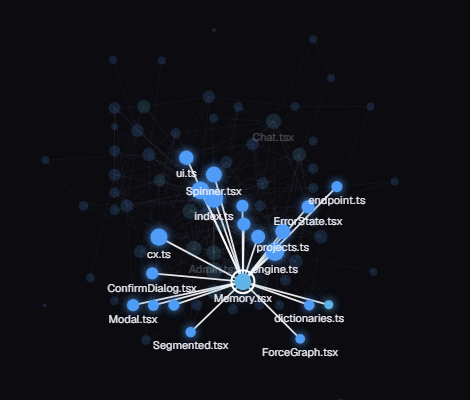
  • Interactive graph: each file is a point, each import a line. Zoom, pan, hover to see neighbors, search and filter by language. Beyond 600 files, the most connected ones are shown.
  • A map without AI: a static analysis of the folder, with nothing sent to a model. An unchanged file is never read again.
  • What agents see: a bounded block of about 1,500 tokens, shown as is, with an honest estimate of the reread tokens saved.
Interactive memory graph of an Elysium project, with one selected file and its neighbors highlighted.
Real rendering of the map on the files of Elysium's interface.

You choose where the AI runs, and you can change it at any time.

  • Providers: Anthropic, OpenAI, Google (Gemini), xAI, Mistral, DeepSeek, OpenRouter, local models (Ollama, LM Studio) and any OpenAI-compatible server.
  • Your own account: sign in with Claude Code or Codex, with no API key. Elysium's session is separate from your terminal's. You can also import a token you generated yourself.
  • Model picker with cost tier, release date, context window and effort level.
  • Automatic routing by task type, or a model set in Settings. A provider that cannot respond is not used, and any replacement is announced, never silent.

Your website or app displays inside Elysium, with automatic updates.

  • Detects HTML/CSS/JS, React, Vite, Vue, Svelte, SvelteKit, Next.js, Nuxt, Astro and Angular.
  • Supervised dev server: free port chosen automatically, address published only when the server really responds, compile errors displayed.
  • Security: confirmation before running a project's scripts, system folders refused, .env files never served, page isolated in a sandboxed iframe.

One page to know what is happening and what is left.

  • Real status of each provider: not installed, not signed in, available, authentication error, quota exhausted…
  • Subscription quotas (5-hour and 7-day windows for Claude Code). Without data, the status is "unknown", never "unlimited".
  • Usage by day, provider, model and agent. Reported, estimated and unknown costs stay separate.
  • Total in euros with a dated, historized USD to EUR rate: changing the rate does not rewrite history.

A catalog of MCP servers with a configuration form.

  • Each installed server has a Test button: Elysium really starts it and shows its tools, or the exact error.
  • Secrets go to the system keychain. The server only receives a minimal environment.
  • Agents with the network permission can use these tools, with your approval on every call (local servers only).

Clean, accessible and up to date.

  • Interface in French, English and Spanish, light, dark or automatic theme, keyboard navigation, reduced-motion support.
  • Honest settings: a setting only exists if it has a real effect.
  • Automatic updates: the app checks for new versions on GitHub, verifies their signature, then offers to install them.